Where Are the Philosopher Kings?
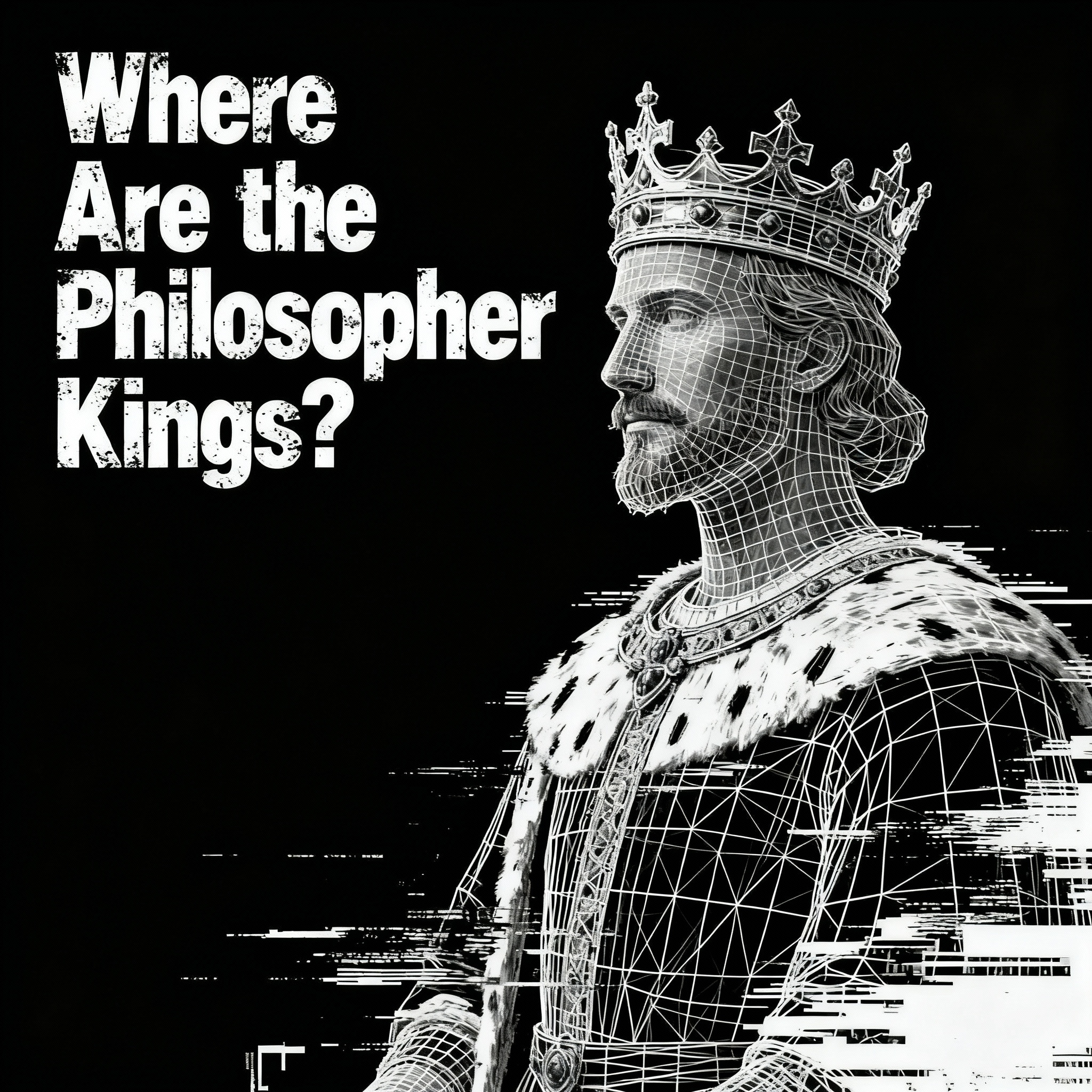
Plato’s philosopher-king—a leader combining wisdom, popular support, and survival instinct—remains one of history’s most elusive ideals. This exploration examines why wisdom and popularity rarely coexist, from Socrates to Theodore Roosevelt, and what it means for modern leadership.We’ve normalized sustainable dysfunction.
Think about that for a second. We live in a state where things barely work, where leaders are openly flawed, where systems limp along crisis to crisis. And because it hasn’t completely collapsed yet, we call it normal. We call it success, even.
That’s not normal. That’s Stockholm syndrome with a broken system.
Plato knew this pattern 2,400 years ago.
The allegory of the cave. People chained facing a wall, watching shadows projected by a fire behind them. They think the shadows are reality. When someone breaks free, sees the actual world, and returns to tell them the truth?
They don’t believe him. They might even kill him for disrupting their comfortable illusion.
We’re still in that cave.
Watching shadows of leaders on the wall. Arguing about which shadow is best. Waiting for the perfect shadow to save us.
Charlie Kirk’s death hit different. Not because of who he was or what he represented, but because of what happened after. The reactions. The rage. The mobilization. The way both sides immediately grabbed their weapons (literal and digital) and prepared for what comes next.
Could be the breaking point. Could be another link in a chain of events that’s been building since... when? 2016? 2001? 1968? Does it even matter anymore where we mark the beginning when the pattern is this old?
America’s heating up. You can feel it in the air, see it spreading through feeds, watch it move like fire through dry grass. And everyone (absolutely everyone) is looking for their hero. Their savior. The one who’ll finally get it right.
The philosopher king who’ll save the republic.
The Promise We Still Believe
Plato sold us a dream 2,400 years ago that we’re still chasing.
The Republic. The perfect state. Governed not by the richest, not by the strongest, not by the most popular, but by the wisest. Philosopher-kings who’d combine truth with power, wisdom with action, knowledge with the people’s trust.
It’s a beautiful idea. Seductive as hell. And we keep reaching for it every election cycle, every movement, every time things get bad enough that we need someone to believe in.
“This time will be different.”
“This leader actually gets it.”
“They’re not like the others.”
We’re still waiting for that perfect combination: someone wise enough to know the truth, skilled enough to implement it, and beloved enough by the masses to actually hold power.
Where are they?
What History Actually Gave Us
We got Socrates.
The wisest man in Athens, according to the Oracle. Spent his life questioning assumptions, exposing contradictions, teaching people to think for themselves instead of accepting inherited beliefs.
The Athenian democracy executed him for corrupting the youth.
Died for wisdom the masses rejected. His students remembered him as a martyr for truth. The city that killed him? They thought they were protecting themselves from a dangerous radical who was poisoning their children’s minds.
Both sides believed they were right.
Then we got Nero.
Hated by the Senate. Despised by the elite historians who wrote our records (Tacitus, Suetonius, Cassius Dio). They painted him as the ultimate tyrant: murderer of his mother, his wives, his rivals. A degenerate who played music while Rome burned. An emperor who violated every norm of Roman dignity.
The common people loved him.
After his death, multiple pretenders emerged across the empire claiming to be Nero returned. People wanted to believe he was still alive. The eastern provinces mourned him. The masses remembered him for public games, grain subsidies, lower taxes on the poor. He was accessible. He performed for them. He was one of them in a way the distant, dignified senators never were.
Two completely different men in the historical record, depending on who’s telling the story.
But here’s what nobody talks about: Nero kept the republic functioning. Flawed as hell, controversial, divisive, but the system didn’t collapse under him. Maybe that’s the real metric we’ve been missing. Not perfection, but sustainable function despite the mess
The Trinity (And Why It’s So Rare)
Here’s the pattern: Wisdom and popularity are almost never found in the same person.
Socrates had truth but the masses killed him for it.
Nero had the masses but truth (or at least the official record) condemned him.
One died misunderstood by the people.
One lived beloved by the people but remembered as a monster by those who controlled the narrative.
We never get both.
Because what we actually need is a trinity, not a duality:
Truth + People’s Will + Survival Instinct
You need all three or it fails:
Truth alone gets you Socrates. Executed, martyred, remembered by students but useless to the living. Wisdom without the ability to stay alive and implement is just philosophical suicide.
People’s will alone gets you Nero. Loved by masses but maybe hollow, unsustainable when power shifts, condemned by those who write the history.
Survival instinct alone gets you every empty politician who says nothing, stands for nothing, just exists to maintain position.
We’ve gotten close exactly once in American history.
Theodore Roosevelt.
Think about it:
Truth: Saw corporate power concentrating into monopolies that would strangle the republic.
Broke up Standard Oil and dozens of trusts while everyone called him radical.
Established national parks because he understood resource depletion wasn’t theoretical. Warned about the “malefactors of great wealth” when being pro-business was the only acceptable position.
People’s Will: Massively popular. “Speak softly and carry a big stick” became the era’s defining phrase.
War hero turned president. Connected with common people while the elites thought he was betraying his class.
Survival Instinct: Took a bullet mid-speech during his 1912 campaign and kept speaking for 90 minutes with the bullet still in his chest.
“It takes more than that to kill a Bull Moose.” The man understood you have to survive to matter.
He had all three elements of the trinity.
And he’s underrated as hell in the historical record.
Most people remember him as “the Teddy bear guy” or “that president on Mount Rushmore.” The trust-busting? The conservation that preserved millions of acres? The warnings about concentrated wealth that proved prophetic? The fact that he actually embodied the philosopher-king ideal?
Barely taught. Rarely discussed outside history classes.
That’s the pattern showing itself.
Even when someone gets close to the trinity, even when they have truth AND popular support AND survival instinct, the system dilutes their legacy. Turns them into a caricature. A face on a monument with the substance filed off.
Because if people understood what Roosevelt actually represented - that the trinity IS possible, that wisdom and popularity CAN coexist, that you CAN challenge power structures and survive - it would be too dangerous to the pattern.
Better to remember him as the energetic guy who liked nature.
The philosopher-king needs all three elements. And they’re so rare we can barely find examples in history because it requires:
Wisdom to know truth
Humility to serve people’s actual will (not manipulate it)
Strategy to survive long enough to matter
Roosevelt had them.
And look what happened to his legacy.
And here’s the brutal part: They’re often not understood until it’s too late.
We kill our Socrates, then build statues.
We condemn our complex leaders, then realize they were holding things together.
We get our Roosevelt, and we turn him into a cartoon character.
The recognition never comes when it matters.
The Question of Authenticity (And Why It’s Still a Trap)
Was Nero’s populism real? Did he actually care about the common people, or was it calculated performance to maintain power against the Senate?
Is modern populism authentic? Do leaders really feel the people’s pain, or are they just skilled at performing empathy while pursuing their own agendas?
Here’s the thing: we’ll never know. And it doesn’t matter.
Because the structure is the same either way. Whether the leader genuinely loves the people or is masterfully manipulating them, the result is identical. A population that’s outsourced their agency to someone else. A mass of people waiting for their hero to save them instead of building their own solutions.
The authenticity question is a distraction. It keeps us focused on evaluating leaders instead of asking why we need leaders to evaluate in the first place.
What We’re Watching Right Now
History doesn’t repeat, but it rhymes hard enough to break your heart.
Charlie Kirk’s death: breaking point or another link? Only time will tell. What matters is the response. The immediate tribal sorting. The rage mobilization. Everyone picking their side, their narrative, their hero or villain.
The pattern is running again.
Political leaders rising with the “answer.” Movements coalescing around personalities. Masses picking sides based on who makes them feel seen, understood, validated. Left, right, center (doesn’t matter). Same structure, different aesthetics. Different flags, same human need playing out:
Find someone to follow. Find someone to blame. Find someone to save us.
The philosopher-kings Plato promised? They’re not in the pipeline. They’re not waiting in the wings. They’re not going to emerge from this chaos with the perfect trinity of truth, popular will, and survival instinct.
Not unless something fundamental changes.
Because here’s what we miss: The philosopher-king can only emerge through the will of the people.
Not despite the people. Not to save the people from themselves. Through them.
Which means the answer isn’t waiting for the right leader.
The answer is the masses acquiring the knowledge to choose wisely.
The Division That Must Be Pierced
The split between wisdom and popularity, between elite truth and mass appeal, between Socrates and Nero, It can only be pierced one way.
The masses must know.
Not be told. Not be led. Not be saved.
Know.
Acquire knowledge. Observe perspectives without having to agree with them. Understand the machinery of power, the patterns of history, the structures that create dependency.
A wise ruler can’t save people who don’t want saving. Can’t lead people who can’t recognize wisdom. Can’t survive in a population that kills anyone who tells uncomfortable truths.
If people stay dependent, stay ignorant, stay tribal, no philosopher-king can exist. They’ll kill them or corrupt them or render them powerless.
But if individuals start acquiring knowledge, observing without picking sides, understanding the patterns - something changes.
The division starts to crack.
Take Fate Into Your Own Hands (The Real Meaning)
This isn’t individualism. It’s not “I got mine, good luck.”
It’s the prerequisite for collective transformation.
Every person who stops waiting for a leader to save them. Every person who acquires knowledge instead of accepting narratives. Every person who builds something that doesn’t require permission or validation.
They become a seed.
A pocket of sovereignty in a system built on dependency.
And here’s the thing about seeds: they’re not meant to stay isolated. They’re meant to proliferate. To show what’s possible. To prove the pattern can break.
The music industry shows this on small scale.
While the masses debate which platform will finally treat artists fairly (Spotify, TikTok, whatever’s next), some producers are building different. Their own sound from synthesis, not sample packs everyone else uses. Their own audience through email, not rented attention from algorithms. Their own infrastructure that doesn’t collapse when the platform changes terms.
They’re not waiting for the industry to save them.
They’re not hoping the next streaming service will be ethical.
They’re not following the popular producers doing what already works.
They’re planting seeds. Building pockets of sovereignty.
And those pockets? They create disruption.
Not through force. Not through revolution. Through existence. Through proving there’s another way.
When enough people see the alternative working, the system that required their dependence starts to crack.
The Tipping Point
There’s no magic number. No mass movement required. No leader needed to kick it off.
The tipping point is individual.
Some people never get there. They stay locked in the pattern, waiting for their hero, blaming their villain, outsourcing their fate until they die.
But some wake up.
They look around at the sustainable dysfunction we’ve normalized and think: “I’ve had enough.”
Enough of waiting. Enough of depending. Enough of this pattern playing out the same way with different faces.
And they start building.
One person. Then another. Then enough that the pockets of sovereignty become undeniable. The seeds become a forest. The disruption becomes transformation.
The ecosystem shifts.
Not because a philosopher-king emerged to save it.
Because enough individuals decided they didn’t need saving.
The IFEELVOID Perspective
Wisdom gets you killed or forgotten.
Popularity might be performance art, might be authentic (doesn’t matter, the dependency is the poison either way).
The crowd will love you until they don’t.
The elites will use you until you’re inconvenient.
The philosopher-kings aren’t coming to save the republic because that was never how this worked.
But the cycle can break.
Not through finding the perfect leader.
Through individuals acquiring the knowledge to become ungovernable by the pattern itself.
Socrates died for truth the masses rejected. Nero lived beloved by people the elite despised. Roosevelt had all three elements and got turned into a cartoon. All trapped in the same broken structure.
The structure breaks when the masses know enough to choose truth AND the wise know enough to survive.
When truth, people’s will, and survival instinct aren’t split across different people but distributed across individuals who’ve taken fate into their own hands.
The seeds are being planted.
The pockets are forming.
The disruption is building.
So When Will You Have Had Enough?
Not abstract question. Practical one.
When will you stop waiting for the platform to be fair?
When will you stop hoping the next leader gets it right?
When will you stop outsourcing your fate to systems designed to keep you dependent?
When will you start building?
The philosopher-kings aren’t coming.
But the knowledge to choose them wisely, to become ungovernable by dysfunction, to plant seeds that transform ecosystems - that’s available right now.
The tipping point is individual.
Some never get there.
Some wake up and decide they’ve had enough.
Which one are you?
Void